10 Best Studio Monitor Active Speakers Of 2026
Studio Monitor Active Speakers — Reviews, Recommendations & Updated Buying Guide September 2026


Edifier MR3 Powered Studio Monitor Speakers
Why We Love It


Edifier MR3 Powered Studio Monitor Speakers
Why We Love It

Sanyun SW208 3" Active Bluetooth 5.0 Bookshelf Speakers
Why We Love It

Edifier R1700BT Bluetooth Bookshelf Speakers
Why We Love It

PreSonus Eris 3.5 Gen 2
Why We Love It

Ortizan Dual-Mode 2.0 Studio Monitors
Why We Love It

PreSonus Eris 3.5-inch Media Reference Monitors (White)
Why We Love It

Edifier MR5 Active Studio Speakers
Why We Love It

Superlux BES3.5 Professional Studio Monitor Speakers
Why We Love It
Edifier MR4 Powered Studio Monitor Speakers
Why We Love It
Quick Pick
10 Best Studio Monitor Active Speakers Of 2026
Quick Pick
Edifier MR3 Powered Studio Monitor Speakers, Hi-Res Audio Certified Bluetooth V5.4 Active Bookshelf Speakers, 2.0 Computer Speaker with Headphone Output RCA AUX Balanced TRS Input - Black (Pair)
Edifier MR3 Powered Studio Monitor Speakers, Hi-Res Audio Certified Bluetooth V5.4 Active Bookshelf Loudspeakers, 2.0 Computer Speaker with Headphone Output RCA AUX Balanced TRS Input (White)
Sanyun SW208 3" Active Bluetooth 5.0 Bookshelf Speakers, Built-in 24bit DAC | 60W Carbon Fiber Speaker, USB and 3.5mm AUX Input, Dynamic 3D Surround Sound, 2.0 Computer PC Monitor Gaming (Pair, White)
Edifier R1700BT Bluetooth Bookshelf Speakers - Active Near-Field Studio Monitors - Powered Speakers 2.0 Setup Wooden Enclosure - 66w RMS
PreSonus Eris 3.5 Gen 2, Studio Monitor Pair, 3.5 Inch, 2-Way, Powered Desktop Speakers for Multimedia, Gaming, Studio-Quality Music Production, 50W Power | Near-field studio monitors, home recording, gaming, multimedia, 3.5-inch woofers, balanced sound, beginner-friendly
Ortizan Dual-Mode 2.0 Studio Monitors, Active Monitor Speakers Bluetooth 5.3 Wireless Computer PC, 80W Power Bookshelf Speakers, Wooden Enclosure for Recording Multimedia, Gaming, Music Production
PreSonus Eris 3.5-inch Media Reference Monitors (White)
Edifier MR5 Active Studio Speakers | 110W Hi-Res 3-Way Monitor + Tri-Amped Crossover | XLR, TRS, RCA + AUX | 24-bit/96kHz LDAC Wireless | ConneX App | EQ + Front Regulator | 2
Superlux BES3.5 Professional Studio Monitor Speakers, Two-Way Active/Passive Design with 50W Output, Woofer & Tweeter, TRS/RCA, Front-Panel Volume Control for Home Studio, DJ, Editing & Multimedia Use
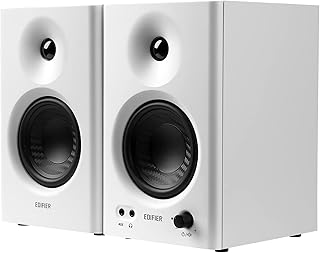
Edifier MR4 Powered Studio Monitor Speakers, 4" Active Near-field Monitor Speaker - White (Pair)
Buying Guide: Studio Monitor Active Speakers
📋 Table of Contents
1What frequency response range should I look for in studio monitor active speakers?
Aim for a flat frequency response between 40Hz to 20kHz for accurate sound reproduction. This range ensures you hear all frequencies clearly, which is crucial for mixing and mastering. Speakers with extended low-end response (down to 20Hz) are better for bass-heavy genres, while those with higher clarity above 20kHz suit vocal and acoustic work.
2How does driver size affect sound quality and room suitability?
Smaller drivers (3-5 inches) are ideal for near-field monitoring in small rooms, offering tighter, more controlled sound. Larger drivers (6-8 inches) deliver deeper bass and are better for mid-field or larger spaces. However, they may require more acoustic treatment to avoid unwanted reflections.
3What’s the difference between active and passive studio monitors?
Active monitors have built-in amplifiers, making them easier to set up and more consistent in sound quality. Passive monitors require an external amplifier, which can offer more flexibility but demands matching the amp to the speaker’s impedance and power handling for optimal performance.
4Should I prioritize a speaker with a built-in DSP or room correction feature?
Yes, if you work in untreated rooms. DSP or room correction features analyze your space and adjust the sound to compensate for acoustic issues. This is especially useful for home studios where perfect acoustics are hard to achieve, ensuring a more accurate listening experience.
5What are the key differences between near-field, mid-field, and far-field monitors?
Near-field monitors (3-5 inches) are best for small rooms and close listening, offering minimal room influence. Mid-field (6-8 inches) are suited for medium-sized rooms and provide a more balanced sound. Far-field (8+ inches) are for large spaces and offer a wider soundstage but are more affected by room acoustics.
How we choose
Our editors are people who genuinely love testing and writing about products. We compare each product's real-world usability and strengths, then distill what matters most into our own "Why We Love It" points — so you get an honest, at-a-glance sense of what counts before you buy.